
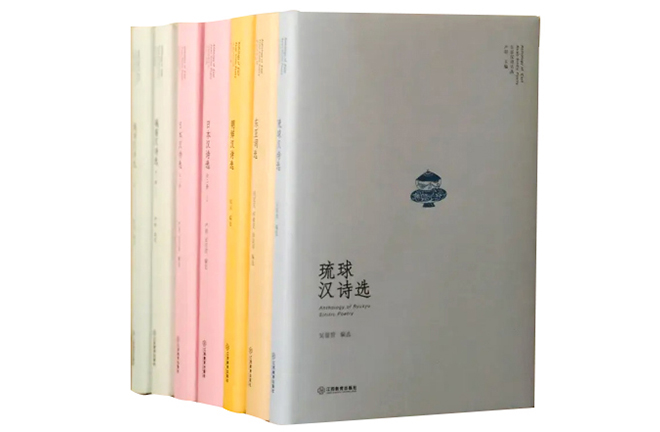
FILE PHOTO: Anthology of East Asian Sinitic Poetry, published by the Jiangxi Education Publishing House under the chief editorship of Yan Ming, showcases the glorious history of the creation of Chinese poetry across East Asian countries.
The academic initiative of “reconstructing the history of civilization” has garnered extensive attention and enthusiastic responses from scholars in China and abroad. Its goal reflects an ambition to strengthen, in a comprehensive way, the discursive power and global influence of China’s independent knowledge system. When we examine the compilation of Chinese literary history from this perspective, several questions arise regarding the hundreds of existing works: Have certain elements been overlooked? Do these histories suffer from insufficient breadth of vision, limited scope, or incomplete conceptual frameworks? This further invites us to ask whether it is necessary to “broaden the history of literature,” and if so, how such an undertaking should proceed.
Within the historical span covered by Chinese literary history lies an enormous corpus of Sinographic literary works produced outside China—a vibrant and dynamic branch that developed overseas. As early as the Tang Dynasty (618–907), Chinese civilization radiated across East Asia, forming a “Sinographic cultural sphere” that long remained under its influence. Countries within this sphere—including present-day Japan, South Korea, North Korea, and Vietnam—absorbed and assimilated Chinese culture while producing vast bodies of Sinographic literature, including fiction, poetry, and prose. These works share the linguistic forms and literary conventions of classical Chinese literature and embody historical and cultural connotations closely aligned with it. Should this body of literature be incorporated into the scope of Chinese literary history—and even form part of a more comprehensive literary history? The answer is unequivocally yes.
Overseas Sinographic literature as a non-ignorable component of Chinese literature
Sinographic literary works produced in East Asia in the pre-modern era can be described as “vast as an ocean.” To take kanshi (Japanese poetry written in classical Chinese) as an example: According to the Bibliography of Books on Poetry and Prose in Classical Chinese, from the Nara period—when kanshi originated—to the Meiji period—when it declined—Japan produced a total of 769 anthologies and 2,339 individual collections. If each volume is estimated to contain one hundred poems, the total number far exceeds 200,000—roughly four times the size of the recently published Complete Tang and Five Dynasties Poetry. Although the full scale of Korean and Vietnamese Sinographic poetry has yet to be conclusively established, current estimates suggest similarly substantial quantities.
Whether these works should be included within the category of Chinese literature remains a matter on which scholars have yet to reach consensus. However, the number of scholars—both Chinese and international—who advocate for their inclusion has been steadily increasing. The renowned Japanese sinologist Kanda Kiichirō, for instance, titled his influential work Historical Sketches of Japanese Ci Poetry with the main title “Chinese Literature in Japan.” To emphasize his academic stance, he stated explicitly in the preface that the book “addresses Chinese literature in Japan—in other words, Japanese Sinographic literature as a branch of Chinese literature.” The Journal of Chinese Studies in Japan, an authoritative publication in the Japanese sinological community, not only features the latest research on Chinese literature but also publishes studies on Japanese Sinographic literature, compiling bibliographies that place both categories side by side as components of “Chinese studies.” If one sets aside the nationality of the authors and considers instead the linguistic attributes, genre characteristics, and historical and cultural connotations of these works, then recognizing them as an overseas branch of Chinese literature is, at the very least, logically tenable within academic discourse.
Taking a step back, even if it may be inappropriate to treat these works as purely Chinese literature—or to equate them directly with traditional conceptions of Chinese literature—they should nonetheless still be incorporated into the research and writing scopes of Chinese literary history. Specifically, when broadening literary history, Sinographic literature produced outside China should be regarded as an important component that cannot be ignored or dismissed. It should occupy a rightful place on the map of Chinese literary history, linked and integrated with the literature produced within China, together forming an interdependent, mutually sustaining, and indivisible artistic whole. Only by advancing this new frontier of overseas Sinographic literature can we broaden existing scholarly horizons and gain a more comprehensive, panoramic understanding of Chinese literature—including classical Chinese poetry—within a broader civilizational context. Ultimately, this may enable the compilation of a Chinese literary history that spans and encompasses the entire Sinographic sphere.
Inclusion of overseas Sinographic literature will deepen Chinese literary studies
The study of overseas Sinographic literature carries an additional significance: As this new research domain continues to expand, our understanding of indigenous Chinese literature will also be deepened and enriched. This implies not only an expansion of the “breadth” of Chinese literary history research, but also a substantial enhancement of its “depth.” For instance, previous literary histories, when examining the influence of writers, works, or intellectual currents, tend to emphasize vertical tracing—investigating their impact on later generations along the temporal (historical) axis, with a focus on identifying lines of inheritance across successive eras. Much less attention, however, has been paid to horizontal mapping—that is, exploring their influence on neighboring countries from a spatial (geographical) dimension and elucidating patterns of cross-cultural borrowing among adjacent regions. By extending our field of vision to encompass Sinographic literature from across East Asia, research may be conducted in a manner that integrates temporal and spatial dimensions, allowing vertical and horizontal lines of inquiry to intersect. This broader perspective yields substantial new material with which to substantiate scholarly conclusions and construct a more comprehensive, multi-dimensional analytical framework.
For example, when assessing the influence of the Tang poet Bai Juyi, a thorough understanding of kanshi in Japan’s Heian period (794–1192) would prevent discussions from being confined solely to poets and scholars of the “Yuan-Bai school” or to the “Bai-style” poets of early Song (960–1279), such as Xu Xuan, Li Fang, and Wang Yucheng. We would also need to account for the numerous instances in which Heian poets revered Bai as a literary idol and adopted his poems as stylistic models, distilling from these examples their far-reaching implications. As is well known, many eminent poets in Chinese literary history were revered and emulated by specific schools of later writers, but such veneration generally occurred within limited spatial and temporal confines. However, during Japan’s Heian period, the fervent admiration for Bai swept through all corners of the poetic landscape, extending to virtually all poets. However, as the divide between China’s indigenous literary tradition and overseas Sinographic literature has long remained unbridged, scholarship has been restricted to tracing the influence of Bai’s poetry within a narrow spatio-temporal range—an inherently constrained approach.
As such, when describing the historical development and transmission of ci poetry during the Tang and the Five Dynasties (907–960), overseas Sinographic literature can serve as a frame of reference—as both a recipient tradition and a source of derivative forms. This enables the discovery of new texts and new evidence that earlier scholarship overlooked. Volume 14 of Keikokushū—one of Japan’s three imperial collections of kanshi—includes five poems titled “yu ge zi” (“Fisherman’s Song”) by Emperor Saga, along with seven responsive poems by Princess Uchiko and Shigeno no Sadanushi. Although categorized as “miscellaneous styles,” these works are in fact among the earliest ci-style compositions in the Japanese poetic circle, representing overseas echoes of the newly emerged ci form from China. What merits attention is not so much their artistic achievement as their inclusion in an imperial anthology, which, from a literary-historical perspective, marks the very inception of Japanese ci composition. Ci’s rise in the Japanese poetic world indicates the increasing richness and diversity of poetic forms and thus serves as a marker of poetic progress. Its trajectory can also clearly be aligned with and used to illuminate the evolution of poetic genres within China. In broadening literary history, such developments should certainly be documented—at least with a brief note. Incorporating overseas Sinographic literature into the compilation of Chinese literary history is therefore one of the most effective pathways for achieving new breakthroughs in literary history research.
An ideal landscape of Chinese literary history
A truly worthy Chinese literary history should not resemble the form it often takes today. It must strengthen its capacity to “trace the transformations of past and present.” Chinese literary history should not merely be a fragmented assemblage or mechanical compilation of discussions on individual writers and works. Rather, it should, through revealing their intrinsic and organic connections, embody the historical continuity and developmental dynamism that the term “history” presupposes. Every subtle link in the chain of literary development must not be portrayed through isolated, static description; it must be understood through a broader, dynamic investigation that integrates both temporal and spatial perspectives, thereby extracting lines of “evolution” and “transformation.” A macro-level literary history is needed—one that is capable of holistically grasping the developmental trajectories of various literary genres, trends, and schools. However, many extant Chinese literary histories appear to be accumulations of micro-level studies and remain unsatisfying in their ability to reveal overarching patterns of change.
To chart new directions in the compilation of Chinese literary history, it is essential to expand simultaneously across two spatial dimensions—within China’s borders and beyond them. Within China, the ancient literary works written in non-Chinese languages by various ethnic groups should be incorporated into subjects of research, thereby reflecting the completeness and richness of contemporary China as a multi-ethnic nation. This is also crucial for fostering a shared sense of identity within the Chinese national community. Beyond China, Sinographic literary works that developed and evolved in East Asian countries should likewise be treated as objects of research and documentation. This would broaden the reach and scope of Chinese literary history and highlight the influence and inclusiveness of Chinese literature—primarily in written Chinese form—echoing, to some extent, the larger aspiration of building a community with a shared future for humanity.
In a broader and more profound sense, the latter is also an integral component in the effort to “reconstruct the history of civilization.” Literary history constitutes an indispensable part of civilizational history, and literary works serve, in essence, as artistic carriers that encode humanity’s spiritual, political, and institutional civilizations through language and writing. Sinographic literary works from outside China are the products of mutual learning, sharing, and deep integration among East Asian civilizations against the backdrop of the widespread dissemination of Chinese civilization. Thus, examining and illuminating the historical processes through which overseas Sinographic literature emerged, evolved, and transformed is not only a necessary supplement to an otherwise incomplete Chinese literary history, but also a foundational contribution to the still underdeveloped history of East Asian civilization. Furthermore, at the intersection of history and contemporary reality, such work may even provide a modest yet significant leverage point for propelling China’s independent knowledge system, as well as Chinese discourse, beyond national borders and onto the global stage.
Xiao Ruifeng is a professor from the School of Humanities at Zhejiang University of Technology. This article has been edited and excepted from Journal of Sichuan University (Philosophy and Social Science Edition), Issue 1, 2025.
Edited by YANG LANLAN